

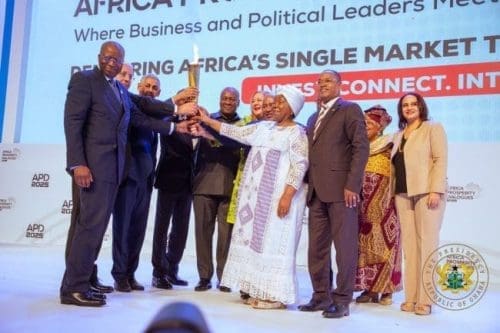
In the heart of Accra, under the gleaming lights of the Accra International Conference Centre, a historic moment unfolded.
The Africa Prosperity Dialogues (APD) 2025, a gathering of Africa’s brightest minds and boldest leaders, culminated in the lighting of the Africa Trade Torch (ATT). This symbolic act, led by President John Dramani Mahama of Ghana, President Faure Essozimna Gnassingbé of Togo, and President Azali Assoumani of the Union of Comoros, marked a renewed commitment to the African Continental Free Trade Area (AfCFTA) and the continent’s collective journey toward economic integration and prosperity.
The APD 2025, themed “Delivering Africa’s Single Market Through Infrastructure: Invest, Connect, and Integrate,” brought together heads of state, business leaders, policymakers, and development partners to chart a course for Africa’s future. The three-day event was not just another conference; it was a clarion call for action, a reminder that Africa’s potential can only be unlocked through unity, innovation, and decisive leadership.
President Mahama, in his address, captured the essence of the gathering. “The decisions we make here must not end in resolutions alone,” he declared. “We must act with urgency, determination, and a shared vision for prosperity.” His words resonated deeply, echoing the sentiments of many who believe that Africa’s time has come. The AfCFTA, often described as the world’s largest free trade area by number of countries, represents a monumental opportunity to transform the continent’s economic landscape. But as the discussions revealed, realizing this vision requires more than just political will—it demands tangible investments in infrastructure, technology, and human capital.
One of the key announcements at the event was the launch of the AfCFTA Transit Guarantee Scheme, set to roll out in 2025. Wamkele Keabetswe Mene, Secretary-General of the AfCFTA Secretariat, described the scheme as a game-changer for intra-African trade. “This initiative will eliminate the need for multiple transit payments, ensuring that goods move seamlessly across borders,” he explained. The scheme, which will initially focus on the Abidjan-Lagos corridor, is expected to reduce trade costs by up to 30%, a significant boost for businesses and consumers alike.
But the challenges are immense. Africa’s infrastructure deficit remains a formidable barrier to trade and development. Poorly maintained roads, outdated railways, and inefficient ports have long hindered the movement of goods and people. The APD 2025 highlighted the urgent need for investments in logistics and transport, with a particular focus on implementing the Single African Air Transport Market (SAATM) and the Africa Integrated Maritime Strategy 2050 (AIMS). These initiatives, if fully realized, could revolutionize Africa’s transport sector, making it easier and more affordable to trade within the continent.
Energy was another critical topic on the agenda. With over 30 African countries experiencing regular power outages, the lack of reliable and affordable energy continues to stifle economic growth. The Grand Inga Dam project, which has the potential to provide electricity to millions across the continent, was repeatedly cited as a priority. Yet, as delegates noted, the project remains on paper, a stark reminder of the gap between ambition and action.
The dialogue also underscored the importance of digital transformation. Dr. Nkosazana Dlamini Zuma, Chairperson of the Africa Prosperity Network’s Advisory Council, urged African countries to prioritize digital communication and financial platforms. “We need a continental-wide mobile interoperability system,” she said, pointing to Ghana’s mobile payment platform as a model for others to follow. The call for regulatory harmonization and investments in broadband infrastructure was met with widespread agreement, as participants recognized the transformative potential of digital trade.
Amid these discussions, the lighting of the Africa Trade Torch stood out as a powerful symbol of hope and unity. The ATT, an initiative of the Africa Business Council, is more than just a ceremonial gesture; it is a rallying cry for the private sector to play its part in operationalizing the AfCFTA. By engaging small and medium-sized enterprises, women, and youth, the ATT aims to bring the benefits of free trade to the grassroots level, ensuring that no one is left behind.
As the torch was lit, the room erupted in applause, a collective acknowledgment of the work that lies ahead. The APD 2025 may have concluded, but its impact will be felt for years to come. The recommendations and commitments made during the event—ranging from infrastructure development to digital transformation—provide a roadmap for Africa’s prosperity.
Yet, the success of these initiatives will depend on one critical factor: implementation. As President Mahama reminded the audience, “The forces that unite us are intrinsic and greater than the superimposed influences that keep us apart.” It is this spirit of unity and shared purpose that will light the path to Africa’s future.
In a world grappling with uncertainty, Africa’s story is one of resilience and hope. The APD 2025 and the lighting of the Africa Trade Torch are not just milestones; they are a testament to what is possible when a continent comes together to chart its own destiny. The journey ahead is long, but as the torch burns brightly, so too does the promise of a prosperous, integrated, and self-reliant Africa.

