

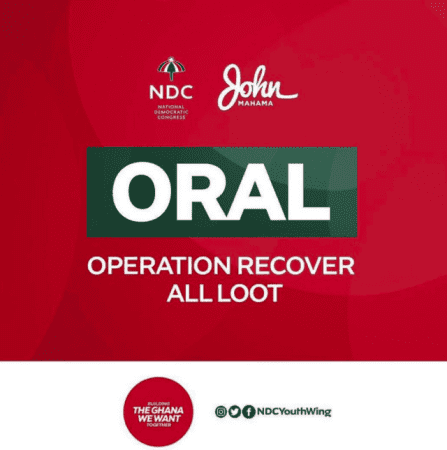
Vincent Ekow Assafuah, the Member of Parliament for Old Tafo, has voiced strong opposition to the newly-formed Operation Recover All Loot (ORAL), suggesting that it reflects a lack of trust in Ghana’s established state institutions.
Assafuah argued that the committee, which he describes as unconstitutional and without legal backing, will ultimately fail in its objectives. Speaking on Key Points on TV3 on December 21, Assafuah emphasized that Ghana already has solid anti-corruption institutions, such as the Economic and Organized Crime Office (EOCO), the Office of the Special Prosecutor (OSP), and the Commission on Human Rights and Administrative Justice (CHRAJ), that are equipped to handle corruption cases. He further noted that ORAL does not possess investigative or prosecutorial powers, and as such, its creation represents a populist approach rather than a serious solution to corruption.
Mary Addah, Executive Director of the Ghana Integrity Initiative (GII), also criticized ORAL, labeling it as a populist measure designed to placate the public. Speaking on the same TV program, Addah argued that President-elect John Mahama should have taken a different approach in his efforts to fight corruption. While she acknowledged the integrity of the members of the team, Addah stressed that ORAL is merely another committee in a long line of similar initiatives that have not led to substantive outcomes. She pointed out that former President Akufo-Addo also established multiple committees during his tenure, which ultimately did not yield meaningful results.
Addah also suggested that Mahama should have directed the public to report corruption concerns directly to the OSP or CHRAJ, rather than creating a new committee. She emphasized that Ghana has well-established institutions for tackling corruption, and that leadership should focus on strengthening these bodies rather than creating parallel structures.
In response to the growing criticism, Mahama clarified that ORAL is not intended to conduct investigations. Rather, it will serve as a focal point for collecting and organizing evidence of corruption, which will then be forwarded to the appropriate state institutions for further action. Mahama explained that the team is not tasked with investigating individuals but will instead gather information from the public to help the relevant authorities take action once his administration takes office. He also clarified that the committee does not have a budget, and that it does not expect any financial compensation.
While Mahama’s explanation may ease some concerns, the criticism from Assafuah and Addah highlights ongoing debate over the effectiveness and legitimacy of ORAL in addressing Ghana’s corruption challenges.

